Jessica Bhardwaj
Professor Ana Garcia
Geology 9
3/12/2018
Week 8
Mass Wasting


Hi everyone, this is Jessica!
This week I will be talking about my country's Mass Wasting.
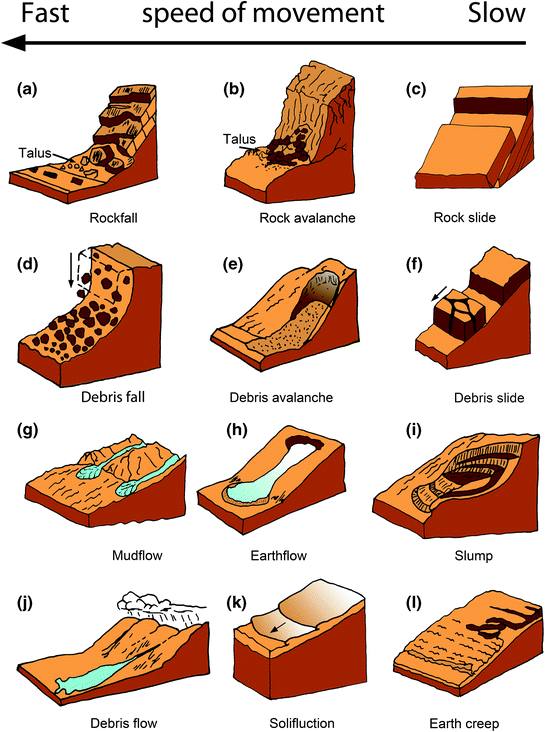
Mass Wasting is the movement of sediment or soil that is going downhill by gravity. First, I would like to list the different types of mass waste there are. The different types of mass wastes are: Falls, Slides, Flows, Slumps and Creeps. Falls are regolith cascades going down a slope, they can occur by being undercutted by running water. They occur at steep slopes, rock materials can get loosened by earthquakes, rain, expanding ice and other things. Slides are something like landslides, its rapid movement of large mass of earth and rocks downhill or on mountains. Can be caused by rainfall. Flows are also like, fluidly, like mudflows, avalanches, debris flows, earth flows etc... Slumps are slipping of coherent rock materials along a curved surface, when they happen it forms a crescent shape. Creeps take a while, the are a combination of small movements of soil and rock, and they go downhill, the steeper the surface, the faster creeps go down.
When I looked up what kind of mass wasting happen in India, I found out that Landslides are the most prevalent in my country. The most recent landslide that occurred in India was back in August of last year. 46 people were killed because of that landslide, two buses and a couple of houses were swept away from the hills there. There were a lot of rocks, boulders and debris that were involved in the landslide. India is always prone to landslides because there are monsoon seasons, and rainfall causes landslides. In India there is a landslide zonation map, some of the listed areas on the map are: The Western Himalayas, Uttar Pradesh, Kashmir, Jammu, West Bengal, Nagaland, The Plateau Margins, and many more. Landslides are serious problems in India, that is why there are also ways that the Indian government tries to mitigate the damage and risk.
Here is a quick list given by the Civil Services Preparation on how to mitigate landslides in India
- Excess water in catchments areas should be stored to reduce the effect of flash floods, this will also recharge the ground water level in areas prone to landslide in India.
- The runoff collection ponds in the catchment areas must be dug to store water.
- On community lands, fuel or fodder trees should be grown to increase forest cover to reduce landslide hazard in India.
- Grazing should be restricted and better grass must be grown on the surface previously grazed to increase the hold on soil by plant roots. These grasses can be of some commercial importance so that economic returns encourage farmers in areas prone to landslide in India.

Sources :
- https://www.cliffsnotes.com/study-guides/geology/mass-wasting/types-of-mass-wasting
- http://www.livemint.com/Politics/PWWZWaeFPN70bXKgh78i8K/All-you-need-to-know-about-landslides.html
- “Landslides in India - Geography Study Material & Notes.” Exam Pariksha, 27 Jan. 2018, exampariksha.com/landslides-in-india-himalayas-geography-study-material-notes/.

Hi Jessica, the intro is great but I cannot see where you have posted the content about your country specifically....would you mind checking this and update your post...
ReplyDeletewow...it seems the population density is also high in those areas in the north with landslides [link]....so I guess the casualties will be expected to be higher there...it is good they seem to be aware of the hazard...
ReplyDeletehttps://upload.wikimedia.org/wikipedia/commons/0/03/India_population_density_map_en.svg